Research
Juyangology
Juyangology studies older adults’ abilities, preferences and living environments through theory and assessment, home safety, age-friendly materials and spatial design, exploring support for independent living, social participation and continued development.
Overview
As people age, their physical condition, ability to carry out daily activities and care needs change. Their living spaces and the services around them also need to adapt. How can older adults maintain their ability to take part in daily activities, live according to their own wishes, stay connected with others and continue to contribute their knowledge and skills? These questions are central to Juyangology. In 2022, Jesse Zhu introduced the concept of “juyang” at a health symposium in Ningbo. “Ju” refers to a familiar and suitable living environment; “yang” refers to a comfortable way of living that allows continued development. Research covers life at home, in the community and in care institutions. It values older adults’ preferences and freedom to make their own choices, along with the environmental, service and institutional support that makes those choices possible. Changes in physical function should not deprive a person of opportunities to participate in life. The experience they have gained can continue to benefit others through learning, exchange and sharing across generations.
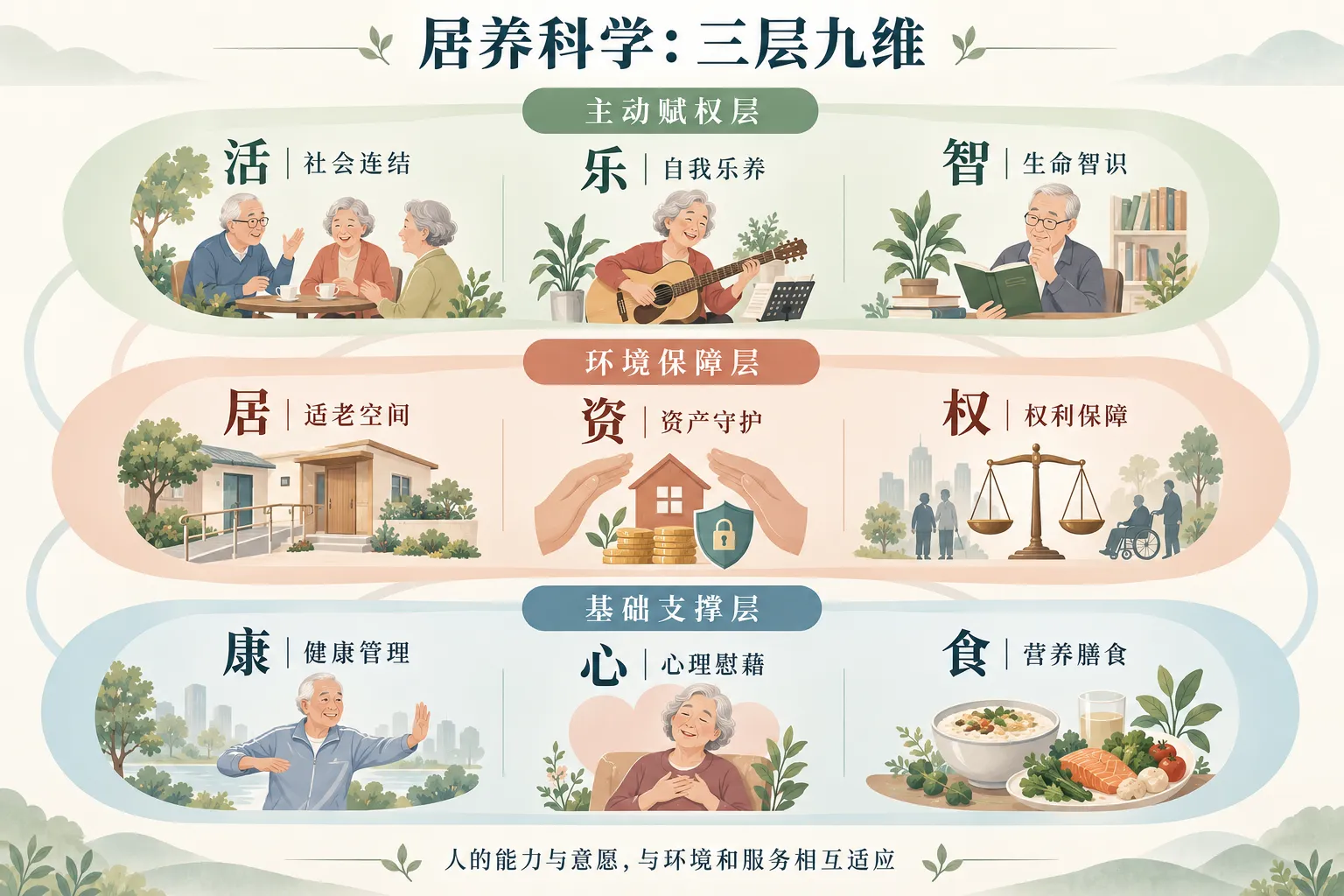
Based at the Institute of Juyangology at Eastern Institute of Technology, Ningbo, this research area brings together natural sciences, humanities, social sciences and engineering to study the relationship between people’s abilities and their living environments. It explores support for different needs across nine dimensions: health, psychological well-being, nutrition, housing, assets, rights, social participation, personal enjoyment and lifelong learning. Research includes the concepts and assessment methods of Juyangology, age-friendly materials, intelligent technologies and spatial design. Their suitability and effectiveness are examined in specific living settings.
Research Topics
Theory and Assessment Methods
This topic examines older adults’ living needs and their relationships with environments, services and institutions, developing a theoretical and assessment framework for Juyangology. Its core principles are personal agency, continued development, an ecological perspective and the ability to enjoy life. The research considers whether older adults can make their own choices, continue to develop, receive suitable support and enjoy life with dignity. The framework of three layers and nine dimensions helps organise specific questions. Foundational support covers health management, emotional support and nutrition. Environmental safeguards cover age-friendly spaces, asset protection and rights. Active empowerment covers social connections, personal enjoyment and the knowledge and wisdom developed throughout life. Together, these dimensions address older adults’ daily lives and provide an analytical basis for research and practice.
Living Environment Assessment and Care Safety
This topic investigates safety risks and the need for age-friendly adaptations in the home, taking account of older adults’ mobility and actual living conditions. The “Shijie” intelligent home environment assessment system uses multimodal data collection and analysis for risk identification, environmental assessment and reassessment, providing information to guide improvements. For falls and unusual activity, the research explores monitoring methods based on human skeletal recognition. The “Matchstick” AI fall-monitoring device represents activity through skeletal information without storing original video of people, addressing both safety needs and personal privacy in everyday care.
Age-Friendly Materials and Everyday Health Support
Research on cooling super-textiles and self-heating fabrics addresses older adults’ thermal sensations and comfort during daily activities, exploring ways to improve clothing comfort and local thermal conditions. The team also studies motion-based exercise suitable for older adults. Using a television and handheld controllers, short and accessible games combine reaction training with physical activity, allowing seated activities to become an option for daily exercise. Related motion-based exercise projects are undergoing community trials and evaluation.
Juyangology Spaces and Future Buildings
This topic examines how spatial environments affect older adults’ behaviour and physical and psychological well-being. Research on leisure and restorative spaces compares the effects of different environmental designs by varying sound, light, colour and scent, and assessing behaviour, physiological indicators and subjective responses. For long-term living needs, the team explores modular and adaptable buildings whose functions and configurations can change as people’s needs evolve, supporting independent living, interaction with neighbours and care when required.